Total vs. Partial Knee Replacement: How Alvin Patients Can Decide
A clear, practical guide for Alvin patients that explains the differences between total and partial knee replacement, typical recovery expectations, and the questions to ask your orthopedic surgeon when choosing the right option.

Why this decision matters locally
Choosing between a total and a partial knee replacement is one of the most important decisions a patient with advanced knee pain will make. At Bay Area Sports and Orthopedics in Alvin (1 Medic Lane), patients often come in after trying conservative treatment and want to understand how the surgical options differ, how recovery looks, and which approach best matches their lifestyle and knee damage. This article walks through the practical differences, what to expect after surgery, and the questions to bring to your consultation so you can make an informed choice with your orthopedic surgeon.
What is a total knee replacement?
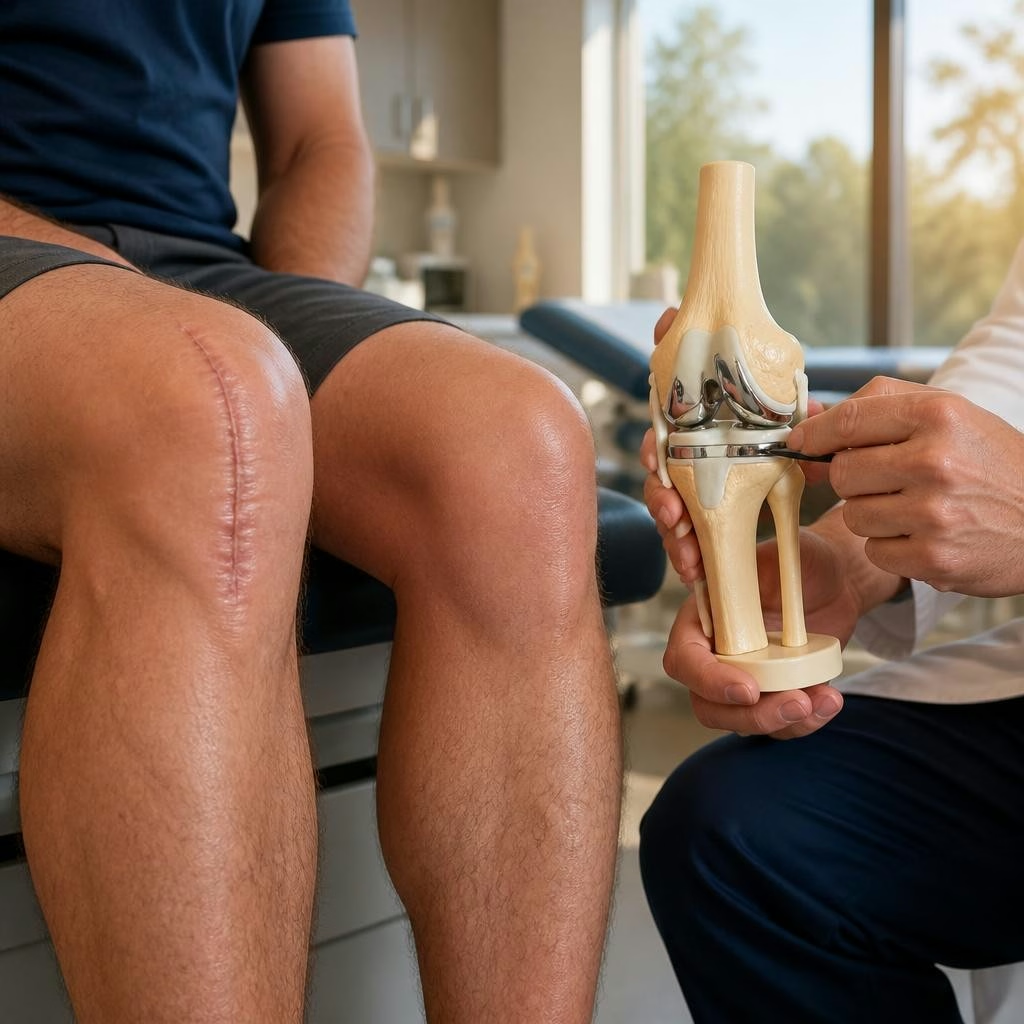
A total knee replacement (TKR) replaces the damaged surfaces of the entire knee joint with artificial components. It is designed for knees where multiple compartments are affected by arthritis, deformity, or widespread cartilage loss. The goal is to relieve pain, restore alignment, and improve overall function. Total replacement is commonly recommended when X-rays or clinical exams show advanced, diffuse joint degeneration that would leave untreated areas painful after a more limited procedure.
What is a partial knee replacement?
A partial knee replacement (also called unicompartmental knee replacement) replaces only the damaged compartment of the knee—most often the medial (inside) compartment—while preserving the healthy bone, cartilage, and ligaments in the rest of the joint. Partial replacement can preserve more natural knee motion and may mean a smaller incision and a faster initial recovery for appropriately selected patients. It is generally considered when arthritis is confined to a single compartment and the knee’s ligaments remain stable.
How surgeons determine the right option
The decision between total and partial replacement rests on clinical exam findings, imaging (X-rays, sometimes MRI), the pattern and severity of arthritis, ligament stability, and your activity goals and general health. Surgeons evaluate whether the disease is limited to one compartment, whether the knee alignment and ligaments are suitable for a partial implant, and whether other conditions (previous fractures, inflammatory arthritis) influence outcomes. A surgeon’s experience and your preferences about recovery and long-term expectations are also part of the discussion.
What recovery typically looks like
Recovery timelines vary with the procedure and individual factors, but both surgeries aim to reduce pain and restore function. Many patients begin walking with assistance the same day or the day after surgery and progress with physical therapy. Some patients report rapid early gains after partial replacement, while total replacement may require a more extended rehabilitation period to restore strength and range of motion. Local patient feedback underscores strong clinical results—for example, a long-term patient described life-changing improvement after bilateral knee replacement—illustrating how successful outcomes are possible when surgery and rehabilitation are well coordinated.
Questions to bring to your orthopedic consultation
Before deciding, ask your surgeon clear, specific questions: Which compartments of my knee are affected and why does that favor total or partial replacement? What imaging or tests support your recommendation? What are the expected risks, benefits, and realistic outcomes for my age and activity level? How long will I be in the hospital and when can I expect to return to daily activities or driving? What does the rehabilitation plan look like, and who will coordinate my physical therapy? How many of these procedures has the surgeon performed, and what does follow-up care involve? These topics help you compare options and set realistic expectations.
Practical next steps at Bay Area Sports and Orthopedics
If you’re in Alvin and considering knee replacement, schedule a consultation at Bay Area Sports and Orthopedics (1 Medic Lane) to review your imaging and goals. Bring recent X-rays or MRIs, a list of medications, and a summary of previous treatments you’ve tried. Reviews from local patients emphasize Dr. Schauder’s thorough, compassionate evaluations and the clinic’s clean, attentive environment—qualities that support a thoughtful surgical decision. Your surgeon will explain whether a partial or total replacement is the safer, more durable choice for your knee and outline a customized recovery plan to help you return to meaningful activities.
Customer review


Article by
Dr. Schauder - Alvin
Dr. Schauder was born in Detroit, Michigan. He received his undergraduate degree from Albion College, Albion, Michigan in 1981 Summa Cum Laude with a 4.0 GPA, Phi Beta Kappa, Albion Fellow.